VBB 385 Naomi Cahn, June Carbone, Nancy Levit: Why Women’s Equality Isn’t!

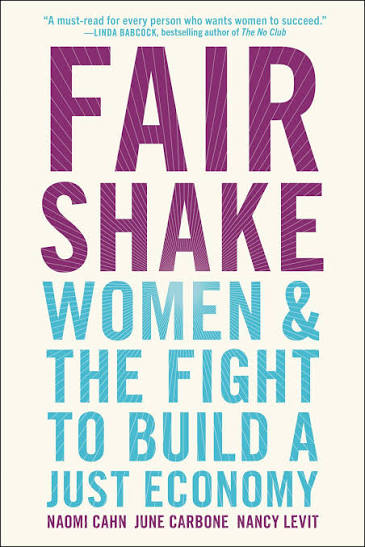
Naomi Kahn, June Carbone, and Nancy Levitt are esteemed law professors and co-authors of Fair Shake: Women and the Fight to Build a Just Economy, which explains how women in the workforce are being shafted.


Naomi Kahn, June Carbone, and Nancy Levitt are three distinguished law professors and co-authors of the groundbreaking book Fair Shake: Women and the Fight to Build a Just Economy.
Together, they explain why so many women feel that, no matter how educated they are, how ambitious and effective they prove themselves to be, or how hard they work, they can’t seem to get ahead or even level the playing field. Research exposes the reasons, and these three legal scholars not only put it in black and white but also discuss with us the kind of betrayal women feel when the rules of the game limit their opportunities and potential.
We discuss why women’s economic progress has stalled, how unproductive competition holds women back, and the triple-bind obstacles they face. But we also explore simple solutions to fix it.
QUOTE: "Women are given a lot of career advice. To lean in. To lean out. To be girl bosses. We think the best advice is to change the system, not the women."
Intro [00:00:01 - 00:00:14]
Virgin Beauty Bitch Podcast, inspiring women to overcome social stereotypes and share unique life experiences without fear of being defiantly different. Your hosts, Christopher and Heather. Let's talk, shall we?
Christopher [00:00:15 - 00:01:35]
What makes a woman a bitch? And who controls the narrative? These are not questions women typically ask themselves, even as they experience the word as a weapon used to dehumanize their gender. So why do we use such a demeaning word in our podcast title? Well, we believe that to change any narrative, first there must be conversation and understanding. So to demystify bitch, the word, the construct, the archetype, or the character, we've committed to hosting conversations around a unique premise that dismantles bitch into an acronym, with each letter used as a puzzle piece to a whole and completely new picture. We begin at the beginning with the letter B. But before we reveal what that represents, first, we are privileged to introduce our guests in this conversation. Esteemed. It's not a word I get to use very often, but it's the perfect word to use as a red carpet for our 3 guests, Naomi Kahn, June Carbone, and Nancy Levitt.
Christopher [00:01:36 - 00:01:52]
Ladies, I've read your bios, and I could never do justice to your accomplishments or your achievements. So would you mind giving us a self-introduction with whatever information you feel motivated to share? Naomi, do you mind starting us off, and then we'll go to June and then Nancy.
Naomi Kahn [00:01:53 - 00:02:13]
Thank you. The 3 of us are absolutely delighted to be here, and I should start by— before we say who we are, I should start by saying this is— the day that we're recording is an auspicious day because it's the day for the release of the paperback version of our book, Fair Shake.
Christopher [00:02:13 - 00:02:13]
Congratulations.
Naomi Kahn [00:02:13 - 00:02:14]
Yes, yes, thank you.
Naomi Kahn [00:02:15 - 00:02:43]
So very, very, very exciting. So, the 3 of us are law professors, law professors currently at different schools. I'm at the University of Virginia, and I teach just a number of gender, socio-inequality-related courses, ranging from family law to poverty law.
June Carbone[00:02:43 - 00:03:20]
I'm at the University of Minnesota and teach whatever is hot and timely at the moment, including property. You're all about to lose your houses, and insurance will become unaffordable. Reproductive rights, gender theory, family law. And I've taught civil procedure and all kinds of other things. Banking. Ask me about the coming crisis. So, and I managed to be a pessimist in every era. And I too am delighted to be here and happy to see you recapture what we're about.
Nancy Levitt [00:03:21 - 00:03:36]
I'm Nancy Levitt. I teach at the University of Missouri at Kansas City. I teach torts, employment discrimination, gender injustice, all the fun stuff. And it has— it's an honor and a privilege to be here chatting with you today.
Christopher [00:03:36 - 00:04:01]
Thank you. Thank you all 3 from the heart, from both of us. Thank you so much. Now, the 3 of you have co-authored on various projects over time, but what caught my eye is your amazing book, Fair Shake: Women and the Fight to Build a Just Economy. The moment I scanned the content, I immediately felt a connection between your subject matter and the word that represents B in our B.I.T.C.H. acronym.
Christopher [00:04:02 - 00:04:15]
I'll begin with this question: knowing what you know from your research and writing, would the word BETRAYAL fit as an overarching theme to your discoveries with the women you've encountered?
Nancy Levitt [00:04:15 - 00:05:08]
Absolutely. The entire thesis of the book Fair Shake, which wasn't its original name; the original name for the book was Shafted, and Simon Schuster said that's too phallic, and we said, duh. So Fair Shake, our thesis is that the new economy celebrates the people who can break the rules and get away with it at the expense of everyone else. That's betrayal. Corporations are operating significantly as extraction devices, and they do this by creating winner-take-all workplaces that pit people against each other for competitive bonuses. Those kinds of practices are linked to hostile bullying and sexist climates, which increase gender disparities at work.
June Carbone [00:05:08 - 00:05:54]
And if I can add, every story in our book is a story of betrayal. We start the book with Betty Dukes. Betty Dukes is the lead plaintiff against Walmart, the largest class action in history, lost on technical grounds in front of the Supreme Court, 5-4, in a reversal of precedent, very much at odds with what the law had been before. But Betty Dukes, you know, this is a woman who had hit rock bottom, then found God. She was about to end it all, and she became deeply religious. She needed a job. She had cycled through retail jobs her entire life. She got hired at Walmart, and she thought, Walmart shares my Christian values.
June Carbone [00:05:54 - 00:06:28]
And she went— steady promotions, part-time, full-time. Full-time to being a customer service manager, the highest managerial position she could get while being an hourly employee. The next step was management training, and they kept saying no to her. She saw the men around her being promoted. She saw younger people being promoted. She wanted to know, why not me? I represent the ethos of this company. And a supervisor said to her, " We don't promote people like you. She thought it was about her rights. And then she discovered that she was the perfect person to be part of the largest sex discrimination class action in history.
June Carbone [00:06:29 - 00:06:57]
And what she didn't know is Walmart wanted people who would break the law and get away with it, who would fail to pay the wages that were required by law, who would exploit their employees, who would violate Christian values, and she had no clue.
Naomi Kahn [00:06:58 - 00:08:06]
I'll add to that that throughout the book, as both June and Nancy have said, we tell stories, and we tell stories— the 3 of us, I think I mentioned this already, are law professors, so the 3 of us use stories from legal cases as a way of showing how women are failed so often by American institutions as they seek justice. And so even when women have power and influence- so even though women are now 11% of all Fortune 500 CEOs, a record number- even that isn't enough to safeguard against discrimination. So the women of Walmart, as June's already talked about, have something in common with women in finance and tech because they're all facing a bro culture and the abuse that that bro culture fosters. And so it's this winner-take-all economy that damages women and, for that matter, damages men too. We talk about women being the canaries in the coal mine, but it damages everybody who is a part of or on the sidelines of this winner-take-all economy. We're all betrayed by it.
Heather [00:08:21 - 00:08:51]
I love how you've already talked on this a little bit, but what I'd like to have a better understanding from your perspective is how each of you in your lines of work would define betrayal, because it's So integral to the conversations we're going to be having around this word, the conversation with each of you today, are the economic impacts and relation of betrayal. But in your work, can you highlight for us your definition of betrayal?
June Carbone [00:08:52 - 00:09:59]
So one of, you know, if I were to say what is the consistent story that you see, it is the women who come into a company who try to do it right, who prosper, who are promoted, and then they hit a point where they're stabbed in the back. Let me give you another example. We talk about a woman at Wells Fargo in the middle of the fake account scandal, okay? And again, she was delighted to have this job. She's Asian American. She describes often being the only brown person and the only woman in these meetings; she gets steady promotions. She explains to us how Wells Fargo made it very hard to know whether there were fake accounts, the information they gave managers. You really wouldn't know unless somebody's telling you. And so, as they get into the fake accounts period, and there's all this publicity. She says, hey, I got to get people to do it right.
June Carbone [00:09:59 - 00:10:29]
So she starts giving lectures. Wells Fargo wants us to open multiple accounts for every person. It makes the customers stickier. Here's how you do it right. Here's how you sell the customers on the idea that it would be useful to have more than one account. She gets written up in the Wall Street Journal as somebody who is encouraging people to create fake accounts. She isn't. She is trying to get people to get— to convince employees to open multiple accounts without them being fake.
June Carbone [00:10:30 - 00:10:58]
And she gets fired. Why does she get fired? Because she got written up in the Wall Street Journal. There was no investigation into whether she had done anything wrong. She insists she hadn't. And she tells the story of how the men around her are doing worse things that blatantly are either illegal or violate Wells Fargo policies, but their bosses are in on it, and the bosses protect them. She gets nowhere. She files a lawsuit. Her lawyer doesn't do much.
June Carbone [00:10:59 - 00:11:29]
She can't get redress in the courts, but she had a great career at Wells Fargo and can no longer be hired in finance. We have a wonderful set of statistics. Men are more likely to commit misconduct. They cause their bosses bigger dollar losses when they do. They are less likely to be fired and more likely to be rehired. That is not true of women who are accused of misconduct, even where the accusations are false.
Nancy Levitt [00:11:30 - 00:12:36]
The theory we have in Fair Shake is a triple bind. And I'll explain the triple bind, but most globally, it is a betrayal because this system traps women in no-win situations under the guise of fairness and meritocracy, when in reality, the system is rigged. The triple bind is this: if women don't compete on the same terms as men, they lose. They're not in the game. And as June explained with the Walmart story, they don't understand the hidden rules of the game. The second leg of the triple bind is that if women do compete on the same terms as men, they are punished more sharply for their sharp elbows or their legal or ethical misdeeds. So, if women are trying to compete on the same terms, they're also losing. Because when scandals need scapegoats, women are convenient ones. And the third leg of the triple bind is that when women see that they can't win on the same terms as men, they take themselves out of the game if they haven't been pushed out already.
Naomi Kahn [00:12:49 - 00:14:06]
So, that's the betrayal in 3 steps through this triple bind. And then you add on top of that the fact that although there's much more equality at home than in the past, women are still the ones who make the plans, engage in more household labor, engage in more child labor— not child labor, engage in more taking care of children, and probably child labor statistics as well. And so it is women who are bearing the responsibilities of what goes on in the home. And so we've seen this in recent reputable Bureau of Labor Statistics reports that women have been exiting the workplace at record numbers. And so there's been a net exodus of women compared to a net influx of men. And so women are facing it in the workplace, and then when they go home, there's the, the, the classic double bind of being expected to do more of the work at home.
Heather[00:14:06 - 00:15:54]
I'm so glad that you highlighted that, because something that I wanted to explore with you 3 as a betrayal that I see in the quote-unquote westernized world is this concept that, you know, women are entering into post-secondary at higher rates than men in many areas, that there is more access to opportunity because, you know, as you've already outlined, the type of blatant discrimination on the day-to-day, not subtle, but the overt discrimination has changed and shifted so much since the '50s, '60s, '70s, et cetera. But to me, some of the betrayal that I'm witnessing as our societies in the Western world evolve is there's this concept that now that we have gained all this access as women, if you are not making ends meet or you're not getting that promotion, and as you've outlined, you know, that, you know, you're playing by the game, but the game's rules affect you differently, but that it's your fault. It's your fault when things go wrong, or you overstep the line, or you're not careful enough to not get caught, or you're just not working hard enough in order to make ends meet. So to me, an element of the betrayal that women are facing economically is the belief that we should be able to be getting equal pay to men and that we have more access to do it, but we're not there. And we self-inflict that that's a personal decision rather than a very systematic plan or continuation of previous ecosystems in the corporate world.
Naomi Kahn [00:15:54 - 00:16:22]
Well, I'll just say one of my favorite brief descriptions of the book is it's not a fix the women, it's not a fix the individual woman book, it's a fix the system book. And so exactly that, it's move away from blaming individual women and instead look at where the blame should lie, which is an overall system. Nancy?
Nancy Levitt [00:16:24 - 00:17:15]
Yeah, you've just, you just hit on something that's so important, Heather. We began the book 7, now 8 years ago. The overall figures seemed to show that women were ever so slowly gaining on men, and it seemed to be that the wage gap was narrowing. But the only— we delved into it, and the only reason that appeared to be so was that the wages for blue-collar men were falling dramatically. When we looked at the numbers divided by college graduates, we found to our surprise that the gender gap in wages was increasing because we, like you, were so used to hearing that women had become the better educated sex. Education was the key to advancement. And yes, by 2000, women were earning more bachelor's and master's degrees.
Nancy Levitt [00:17:16 - 00:18:00]
By 2006, more doctorate degrees, but it was in those groups, the ranks of college graduates as a group and the highest earners among college graduates in particular, where the gender disparity had grown at the fastest rate. And in fact, there are studies showing that the gender wage gap increases with education. For high school or less, the gender wage gap is about 20%. College or advanced degree, 25%. Doctorate degrees, more than that. There was a Goldman Sachs study that showed if present trends continued, women wouldn't catch up with men in terms of wages for another 100 years. I think that was a 2019 study. By the time we finished the book last year, we realized if present trends continue, women will never catch up.
June Carbone [00:18:01 - 00:18:37]
And I want to emphasize why. So when you look at the financial crisis, take the snapshot. Of things at the financial crisis, at that point from 1982 until the financial crisis, 57% of all increases in wages went to finance. And as that accelerated, women were making gains in finance in the '90s. Those gains decreased; they decreased in low times, and they decreased in boom times. After the financial crisis, the big shift is to Tech.
June Carbone [00:18:37 - 00:18:37]
And you've got to look at the startup world. And what you find again is that women got to be 10% of venture capital players by 1999. That then fell to 6%, and it began to go back up only with the recovery after 2014. But there is another tech bust. In fact, if you want to explain the 2024 election, I think you have to look at how angry the tech bros are at the fact that they were in the middle of an enormous slump. And when you look at the slump, what you find is that women-headed startups were doing better. They were burning through cash at a time when it was harder to get refinanced, a lot less quickly than the bros. They were making it to an IPO, you know, public offering stock market, or being bought up by a larger company faster than the bros.
June Carbone [00:19:33 - 00:20:05]
What they weren't doing to the same degree is being the next Mark Zuckerberg or Elon Musk. And so, when you have that kind of world that says, hey, we're going to gamble, you win big or bust. And while you're betting, you also treat yourself to all kinds of parties and stock options and that kind of stuff. You see the guys with sharp elbows. Elbowing out the women. But when the downturn comes, the women are often the last people left standing.
Christopher [00:20:05 - 00:20:28]
There are a couple of things. First, I remember it was 2009, and the Dalai Lama said, " The world will be saved by the Western woman. Do you remember that? Was he delusional, or was it just the time and things have changed that much since 2009?
June Carbone [00:20:31 - 00:21:31]
Oh, I see that definitely happening. And you know, you have Fortune 500 companies. Women went from 6% a year or two ago to 10%. And I think this year to 11%. But the women-headed companies are outperforming the men. So, when the next crash comes, I predict it will be some mix of the crypto boys— who knows what's going on with AI, but it is the single biggest source of new investment in the economy- and it's hugely speculative and risky. Hedge funds, my investment friends all tell me hedge funds and private equity, totally opaque and in trouble. Women executives in mainstream financial firms increased by 40% over the last several years, not in hedge funds and private equity.
June Carbone [00:21:31 - 00:21:55]
These are the vulture capitalists of the economy who move in and destroy companies like Toys R Us. And, you see very few women in— it was something like this incredible trillion-dollar set of money swishing around and investing in things. 97% of the people running it are white men.
Naomi Kahn [00:21:56 - 00:22:40]
But you also— I mean, I love that quote. Thank you so, so much. You also see women becoming more likely to start up companies as they see what's going on in the workplace. Women often start companies because they want more flexibility. It gives them more independence and autonomy. There's a report in Forbes about women starting close to half of new small businesses in 2021. So a dramatic increase. And we do also want to say that not all women are the same.
Naomi Kahn [00:22:41 - 00:23:12]
Not all women are— there are plenty of women who are part of bro culture. There are— so we don't want to say there's a sameness there and women will inevitably lead. We do want to say that there are feminine values values of cooperation, of equality, of working together that will in fact give truth to that statement that you started us with.
Nancy Levitt [00:23:13 - 00:24:25]
And if I can just add to what Naomi said to pick up on the feminine values theme, it isn't just women who will make the future better; it is people who embrace those feminine values of collaboration, nurturing, relationship building. Those have traditionally been considered female qualities of leadership, but men can embrace them too, and those are the executives who are succeeding. There was an interesting Forbes report. I think it was from last year, and it showed that companies that have women executives are 30% more profitable. More likely to outperform other companies. So we see a little glimmer of hope there for the type of leadership that circles around feminine values. We also see a little bit of hope in terms of political grassroots movements.
Nancy Levitt[00:24:25 - 00:25:05]
I live in Kansas, and there was an episode in our recent past in which there was an effort to promote what was called a Value Them Both campaign. It was to create a legislatively referred constitutional amendment to the Kansas Constitution to undermine a decision of the Kansas Supreme Court that had said women have certain choices. And the Kansas referendum went to the voters, even voters in rural counties. I mean, the amendment is ultimately defeated. I think it was like an 18-point margin. And that was attributed to higher turnout. It was attributed to an increase in voter registration. And I think those are going to be hugely pivotal as we move forward in this political moment.
Christopher [00:25:06 - 00:25:29]
You 3 are amazing. Because I said— I started that dialogue with there are 2 things. The first thing was the Dalai Lama. The second thing was this idea of feminine and masculine, which is things that Heather and I talk about a lot on our podcast. And you all 3 hit that note without me saying a word. I love that. Thank you.
Naomi Kahn [00:25:29 - 00:25:30]
Thank you.
Heather[00:25:31 - 00:25:56]
I do want to give homage to what was said there because I think that that quote can be very easily taken and adored by Western women. But ultimately, when we see women or people embracing those quote-unquote traditional feminine characteristics worldwide, that makes a huge impact as well. You know, women who are given loans or microloans worldwide that then take it and give back to their families and their communities. Like those stories, in my eye, are just as important for us in the West to hear and learn from as potentially them being able through the internet to hear our stories of success and striving for equality. Because for every person that strives for better equality and more, ultimately more power for women to create equality amongst gender, That, that, that is a huge piece of what we're all creating. So, I want to give homage to women worldwide that are also teaching us.
June Carbone[00:26:37 - 00:27:22]
Yes. So, what we argue in the book is that because women can't break the rules and get away with it. When you see a company, an institution in which women are succeeding or rising to the top, They're operating differently. And NASDAQ, you know, the stock exchange, had this whole report. When you see women on boards, when you see women in— and it's also true, women in upper management ranks— you see less securities fraud, less accounting manipulations, more accurate accounting reports. You don't even need manipulation. The eyes are crossed. Ts are dotted, and the company is better run.
June Carbone [00:27:23 - 00:28:37]
Now, this isn't because men can't run companies effectively. It is because women can't break the rules and get away with it. So if you see women in upper management ranks, you know that the odds go up substantially that the information that's being put out about the company is accurate, that they're not taking ridiculous risks to stoke the ego of the great leader, uh, that, uh, they are promoting people who are effective in their jobs rather than the buds who will help the CEO achieve short-term gains to boost everybody's bonuses at the expense of long-term company health. NASDAQ then said, hey, we at least have to have Numbers showing how many women are there. And what happened? Conservative judges said, oh no, NASDAQ doesn't have the authority to do anything like that. DEI is— and of course, the Trump administration has doubled down. DEI is bad. We're saying simply knowing the numbers gives you an important signal about the health of the company, the health of the economy. And women could be the leaders of the new organization, men who look out for more than goosing share price tomorrow to increase bonuses at the expense of the long-term company health.
Christopher [00:29:00 - 00:29:09]
What can be the tipping point? Because as we speak, as we have this conversation, I see healthy salmon swimming in shark-infested waters.
June Carbone[00:29:11 - 00:29:22]
Oh, I have a picture of this that I use in The Toxic Edge. It's a school of fish, a huge school of fish swallowing up the small fish operating on their own. And the school of fish are the oligarchs and the companies they run, which are no longer brick-and-mortar companies; they're networks.
Heather [00:29:54 - 00:29:54]
What you've each said about different aspects, whether it's not being able to play the same game because when we get caught we have different penalties, to despite the record numbers of women rising into different educational advancements, that, that not being equated to the type of compensation they receive after school and into their careers.
Heather[00:29:54 - 00:31:20]
But I was hoping to touch on with each of you is a little bit more of the personal side of internalized betrayal, where there is almost a chronic undervaluing of how we perceive ourselves or our voices or our ideas, whether that's us saying our ideas in a boardroom or in our workspace. You know, it's like Dolly Parton's song. It still rings true today in so many ways that, you know, you say your idea, some other man takes it, and all of a sudden it's a good idea. I feel like every woman has been there. You know, something Christopher and I have talked about, like, that, that still happens. But not only does that happen- not revisiting it to say, oh, actually, Jack, but that's also what I just said- and taking ownership for it again to not want to rock the boat. I know that this, you know, women do do this, you know, they will call it out in some spheres. But between that fear of negotiation, self-worth affecting our negotiation skills, so the more like kind of internalized views of our value and what we contribute to the working world and to the economy, and that the fact that we've internalized these perceptions of our worth and our ideas, that that in and of itself is a personal betrayal based off of this economic betrayal.
Heather [00:31:21 - 00:31:50]
In your experience, have there been pieces that you've found helpful? I mean, clearly, I know like mentorship's been a buzzword for so long. Clearly also, you know, the therapy that women are doing to build up their own voice, understand their patterns, their sense of self. But what have you found in how maybe that's shifted over time, this more personalized lens of how we view ourselves and how it impacts our economic standing?
Nancy Levitt[00:31:50 - 00:33:10]
We get asked this question a lot, or some form of this question, which is, what can women do? Women are given a lot of career advice. To lean in. To lean out. To be girl bosses. And as Naomi said earlier, we think the best advice is to change the system, not the women. And to that end, what we think women can do is to keep critically connecting the dots between the abuse of power and the treatment of vulnerable people. In other words, to externalize. I mean, collective action and sunlight are really the best responses to the kind of betrayal that you're talking about, to the winner-take-all economy that we're talking about. Women fight back most effectively when they expose the ugliness. This was the MeToo movement, right? For centuries, women suffered indignities and assaults in silence, and after actor Alyssa Milano in 2017 tweeted a term that activist Tarana Burke developed in 2006, #MeToo. Within a year, there were 19 million #MeToo tweets, and those were calls for action and for accountability.
Nancy Levitt[00:33:11 - 00:33:48]
And #MeToo served as a form of jiu-jitsu. It used the power— it turned the power of celebrated men to act with impunity into a weapon against them and use their very celebrity to topple them. And so this idea of speaking out, the idea of reaching out as part of collective action, that moves in the direction of feminine values, right? Women have been at the forefront of advancing win-win strategies. And we think this will lead to a community That's more than the sum of the parts.
June Carbone [00:33:50 - 00:35:00]
When I look at this, to add a different lens on it, it's that when we describe what the change is about, that is, that the core affairs shake, it's a move from institutionalized power to personalized power. And almost no woman strides into the room and commands it the way the charismatic and reckless CEO does. But institutions matter. They confer authority. They command loyalty. And I see the military and the values of the military, for better and worse— I mean, it is about conformity as well as about community— but it's the last institution left that is being dismantled. That still has respect as an institution because the institution is greater than the individuals. Dwight Eisenhower won out over Douglas MacArthur, Eisenhower being the ultimate bureaucrat and MacArthur, General MacArthur, being the reckless, egotistical guy who was about personality.
June Carbone [00:35:00 - 00:35:28]
And that's what we've lost. Women do fine. As institutional leaders cloaked with the mantle of institutional authority, when the goal is to break free of that, to do what Uber did, or Facebook, move fast and break things, with the emphasis on the breaking things. That's the world in which women continuously are being stabbed in the back.
Christopher [00:35:28 - 00:35:30]
That's very, very powerful. I think all 3 of you touched on a theme that Heather and I are working towards, and that is in these conversations that we're having and these topics that we're covering, what our hope is, is that we can build a community of like-minded women who help each other, who work with each other, who mentor each other through the things we're talking about right now. It's that school of fish you're speaking about, right? Building that for real. That's an undercurrent of what it is these conversations we hope will produce in time.
Heather [00:36:07 - 00:38:30]
Just to summarize, you know, the amazing insights from each one of you, especially with that final question, I love that, you know, you've shifted in some of what you had to say, the reality of the institutionalized power versus really building on your own personalized power beyond an institutional requirement for you to kind of have instilled that vision in yourself. But also, again, to not make it about just the individual woman so that she doesn't fall into the trap of it being her not being enough versus the systems that are very much alive and well that keep women in these positions. And also, like, for me, what's kind of surfacing for me is so many of, like, the Fortune 500 numbers or the numbers that we're gaining with women leading countries or rising into different positions of power in politics is there's almost a bit of an undertone of, you know, you're lucky to be here, to be that one person or that one woman in the— in whatever sphere it is that they've broken new ground. Whereas I think we're starting to shift in, you know, that position, that country, that Fortune 500 company is lucky to have you, right? Your insights, what you bring to the table, what your lived experience means for how we're changing the game, or changing how a company runs. But I would appreciate your thoughts on this, considering what we've already talked about, that I feel women are somewhat- whether it's told or we kind of pull an economic message for ourselves as women- often that message from economists and the economic elite is that it's very confusing. And there are so many intricacies of the economy that are kind of beyond our control, or there are different theories of, you know, Keynesian economics and things that I feel ultimately have been very outdated with trickle-down economics and all of these things that don't hold weight, I think, for a lot of people anymore. But with your work, what sort of economic vision would— and I know we started on this as well, but what economic vision do you have beyond kind of what women have been sold?
June Carbone [00:38:30 - 00:39:01]
Well, I'd like to get in this era. When we were working on the book, I would've given a different answer. The answer I give today is the Dalai Lama's. Hey, bad times are coming. I mean, one way or the other, we are looking at what is likely to be major. Let me, let me give you one little idea. When we looked at CEOs, I mean, CEOs are narcissists. There are actually pieces glorifying the narcissistic CEO.
June Carbone [00:39:02 - 00:39:48]
And we looked at the numbers, and came up with 2 big things: One, men who are rated as narcissists by their employees are rated as more effective bosses. Women who are rated as narcissists by their employees are rated as less effective bosses. Can't win. But narcissists generally cause more big losses and more big gains. But the most recent studies net it all out; it's more really big losses. And when you ask the question, what happens afterward? This is the pickup of pieces. I mean, I say we had the postwar era, a period, an era of relative prosperity and relative equality, only because of the Great Depression and World War II. And what took hold in the aftermath of really horrific events were feminine values.
June Carbone[00:39:56 - 00:40:49]
Equality, community, looking out for more stakeholders, not everyone, not complete equality. Hey, I remember the '50s. I'm old enough. But, but in relative terms, the triumph of values of community, equality, prudence. And what we have today is the opposite. There's a crash coming. The only question is how soon. And when we then rebuild, the question is, what kind of world do we rebuild? And I'm optimistic that women can be in a position, that women-led companies, women-led startups may be the last institutions still standing, and that the values at their core look out for everybody, rebuilt community.
June Carbone [00:40:50 - 00:41:18]
It is not about dominance. It is about the rose garden, not about the cement overlay so you can have a patio at the White House. If you think about that image of a rose garden, it requires tending and requires sensitivity to the environment and requires attentiveness to how the individual pieces fit together. That's the image I want to leave us with.
Christopher [00:41:19 - 00:41:58]
I cannot express how grateful we are to have this quality and depth and conscience of conversation about topics that women live with day-to-day, to-day, however often there is no outlet for that to come out, to express itself, to be known. This means so much to us that you 3 have dedicated your time to have this conversation. Thank you. I cannot thank you enough for this.
June Carbone [00:41:59 - 00:42:01]
Thank you. And thank you for asking these questions.
Heather [00:42:02 - 00:42:24]
Well, I think it is a very serendipitously beautiful day, as you're saying, with the release of the softcover. So I cannot wait to get my copy. It sounds tremendous alongside your very enriching work that you've done individually to have this culminate together. I cannot wait to read it.
Christopher [00:42:24 - 00:42:45]
And for everyone, that is, that is Fair Shake: Women and the Fight to Build a Just Economy. Thank you. I'm just overwhelmed. I'm completely overwhelmed by what you've given us here today, Naomi, June, and Nancy. Thank you so much. We appreciate you.
Christopher [00:42:45 - 00:42:51]
And you have been listening to
Heather
The Virgin,
Christopher
The Beauty,
Heather
And the big B of betrayal in BITCH.
Christopher [00:42:52 - 00:43:32]
Come on back because we are going to be walking through this acronym that we've created as time goes on over the next few weeks. So come on back, please join the conversation. We'd love to hear your perspective on what it is we are bringing to the table. Well, thank you for listening. We really appreciate it. To become a partner in the VBB community, we invite you to find us at virginbeautybitch.com. Like us on Facebook, Instagram, and LinkedIn, and share us with people who are defiantly different like you. Until next time, thanks for listening.
Law Professors | Co-Authors
Fair Shake: Women and the Fight to Build a Just Economy. “A stirring, comprehensive look at the state of women in the workforce—why women’s progress has stalled, how our economy fosters unproductive competition, and how we can fix the system that holds women back.”
The authors:
Naomi Cahn — Distinguished Professor of Law at the University of Virginia School of Law, an expert in family law, trusts and estates, feminist jurisprudence, and reproductive technology. Her beat is gender equity in the workplace, with a particular emphasis on economic inequality and family roles. Her work has been featured in the New York Times, Washington Post, Wall Street Journal, and New Yorker.
Nancy Levit is the associate dean for faculty and holds a curator’s professorship at the University of Missouri–Kansas City School of Law. She teaches Defamation & Privacy, Employment Discrimination, Gender & Justice, Jurisprudence, and Torts, and serves as a faculty advisor to the UMKC Law Review. She is also a member of UMKC’s Women’s and Gender Studies faculty and has previously taught Criminal Law and Constitutional Law.
Professor June Carbone of the University of Minnesota Law School is an expert in family law, assisted reproduction, property law, and law, medicine, and bioethics. She has also taught contracts, remedies, financial institutions, civil procedure, and feminist jurisprudence. Throughout her career, she has focused on the intersections of law and economics, law and science, and law and society.


