VBB 384 Dr. Beth Hedva: Why Betrayal is Essential to Healing!
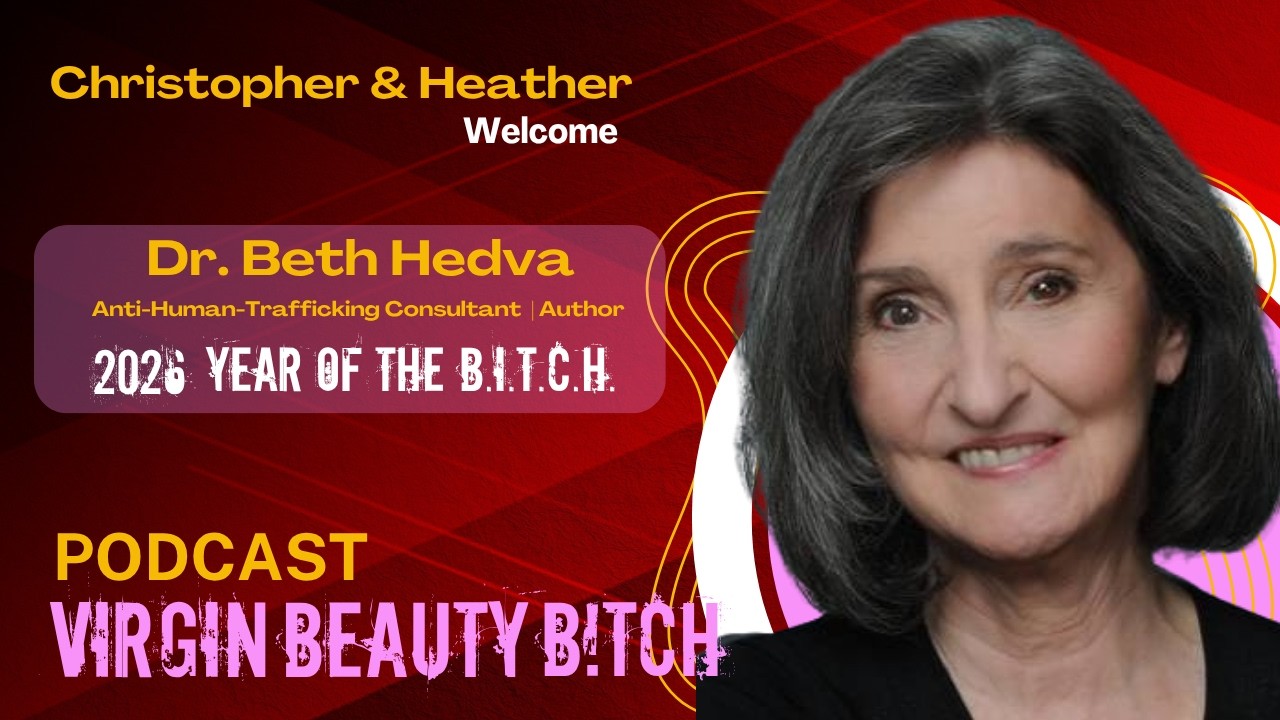
Dr. Beth Hedva illuminates how words like Bitch can be reclaimed and how painful experiences, such as betrayal, can become a transformative force.


Dr. Beth Hedva was our obvious first inviter for our Year of the BITCH series. Dr. Hedva is a renowned psychologist, author, and expert in transpersonal therapy, whose groundbreaking research on betrayal, trust, and forgiveness is recognized by governments and the United Nations, which call on her to help individuals heal from deep emotional wounds.
Betrayal, we’ve all experienced it, sometimes as the perpetrator, sometimes as the victim; either way, the word comes loaded with pain, anguish and suffering. However, Dr. Hedva points out that betrayal is also a necessary experience that can lead to self-discovery and personal empowerment. How that can work in your life is a must-listen. It’s important to know that Dr. Hedva is a pioneering psychologist and the award-winning author of Betrayal, Trust and Forgiveness, which delves deeply into the concept of betrayal and its profound potential to foster healing. For women, this can manifest as newfound resilience, strength, and agency. This conversation invites you to know betrayal beyond the perpetrator or the victim.
Christopher [00:00:01 - 00:01:08]
Virgin Beauty Podcast, inspiring women to overcome social stereotypes and share unique life experiences without fear of being defiantly different. Your hosts, Christopher and Heather. Let's talk, shall we?
Bitch! It’s a word that comes with a reputation that doesn't need to be earned. For half of the human population, bitch is a birthright that's as inevitable as menstruation. Every woman will literally be cursed by that word. So why do we have such a cursed word in our podcast title? Well, it's because we have learned from some amazing women that there is a true power in that word. So we are going to dedicate a series of episodes exploring that point of view. The first step is that we've separated bitch into an acronym, and we begin at the beginning with the letter B.
Christopher [00:01:08 - 00:02:03]
But before we reveal what that letter represents, we are privileged to introduce our first guest in this series. She is Dr. Beth Hedva, a licensed psychologist, marriage and family therapist, international lecturer, and a pioneer in transpersonal therapy. In fact, she is a co-founder of the Canadian Institute of Transpersonal and Integrative Sciences. Her five-step spiritually directed therapy protocol is recognized by the UN Ethics Symposium on Human Rights Violations and Recovery. And the UN has called on her, called her into action for humanitarian missions in some of the deadliest disasters of our century. Dr. Hedva also works on reconciliation and healing between indigenous and non-indigenous Canadians.
Christopher [00:02:04 - 00:02:20]
But how do we know Dr. Hedva is an award-winning author of Betrayal, Trust and Forgiveness, a guide to emotional healing and self-renewal? Welcome, Dr. Beth Hedva, to Virgin Beauty Bitch.
Dr. Beth Hedva [00:02:20 - 00:02:26]
Thank you so much for that introduction and for putting it within the context of owning our feminine power.
Christopher [00:02:26 - 00:02:50]
Oh yes, we will definitely get into that. Now I'm willing to bet, though, that bitch wasn't part of your research, or the reason for writing your book Betrayal, Trust and Forgiveness. But it just so happens that when Heather and I put together our vision of the word, we were in sync with the same starting point: betrayal. I think it's a good place to begin, maybe hearing your definition and how the word inspired your book.
Dr. Beth Hedva [00:02:51 - 00:03:34]
So the word betrayal, already, is a kind of interesting word. I like to go into the roots of words, and the word betrayal comes from the Latin root tridare or tradiri. And it has to do with tradition. It's the same root as well as the word traitor is from the same root. And when we're looking at that experience of betrayal, we betray the traditions. We become traitors to that which has been handed down to us as a required social convention. And when we betray that, we end up having a difficult time, oftentimes, especially as women. Now, there's also the opposite side of betrayal.
Dr. Beth Hedva [00:03:34 - 00:04:14]
We look at trust. And trust is that theme of it comes from the root word trio, which is an Old English word, which stands for tree, trust, truth, betrothed, all of those words. And there is an inner truth that we can trust that can become our sacred troth. That's one of the other words for trust. And we kind of betroth that we live that we unite with it. When we do that, people will sometimes think of us as betrayers. Betrayer of what is expected of us. So I hope that kind of puts a context around it.
Christopher [00:04:14 - 00:04:23]
Yeah. You mentioned in your book, you said, that my interest in betrayal sprang from my own inner work with my unconscious feelings. What was that process?
Dr. Beth Hedva [00:04:24 - 00:05:27]
Oh, well, you know, it was really interesting. I found that there was a phase in my clinical practice where it sounded like absolutely every person in my practice was coming in with a betrayal story of some sort or another. And so I began researching the archetype of betrayal and how it shows up across all cultures as an experience that awakens us. And right as I was beginning to put all of that together, my former marriage partner. We did not break up over this, by the way. But I do want to mention that he came to me, and I was just beginning to lecture on this publicly, mind you, so the timing couldn't have been better. He came to me to tell me that he didn't love me anymore, he had fallen in love with somebody else, and that, you know, he was looking at wanting to end our relationship. And so there I was teaching about the experience of betrayal and the steps to move from betrayal to trust to healing.
Dr. Beth Hedva [00:05:27 - 00:06:21]
We're used to going from trust to betrayal, but we don't know how to go from betrayal to trust. To trust the process. And how is betrayal part of the process that inspires us and awakens us? And the seed for this piece of work actually came when I was doing a course with a fellow named Brew Joy, who was a teacher down in California and an internationally renowned teacher. And we were doing kind of like an inner guided meditation. And in the process of that meditation, I realized that I had a deeper sense of knowing beyond what my mother, for example, knew. And it started with, and like really, who would even consider this a betrayal? Nobody, except I did.
Dr. Beth Hedva [00:06:21 - 00:06:52]
She was dressing me for a party to go to. You know how our elementary school friends all have first names and last names? So I was going to Peter Glasgow's Birthday party. And she was dressing me in this pink party dress. And I did not want to wear that pink party dress. I wanted to have nothing to do with it. But nonetheless, there she was, dressing me in that, dropping me off at his house, and all of the other children were dressed in play clothes. And I heard two mothers talking about, well, she must not have read the invitation. It said play clothes on the invitation.
Dr. Beth Hedva [00:06:52 - 00:07:59]
And suddenly I felt betrayed by my mother. You know, not a big deal. Not like sexual abuse or physical abuse or anything like that, but it was a sense that I had a deeper sense of knowing, even though I didn't read the invitation, and that I was not given the permission to go with what it was that I knew would be more appropriate. And so that was kind of like the seed that I started seeing showing up in the lives of my clients, in the stories that were on the news, in the experiences of politics and society. But it hits us in a very personal way. That's the thing about betrayal. It takes us into a depth of soul that is so profound and so shocking to our soul that in order to heal from it, we have to find our way through and beyond that experience of shock and trauma. So mine was pretty innocent, a pink party dress.
Dr. Beth Hedva [00:08:01 - 00:08:37]
But it led to this whole awareness that there is a deeper knowing inside. And to me, that was the original experience of what I called betrayal of the mother, the archetype of the mother. And our mothers, of course, are supposed to know what's best for us. But guess what? There's a deeper knowing. The source of nurturance and knowing within each human being that we can trust from within ourselves, from the inside out. So that was kind of like the seed that led to writing the book, and then many betrayals beyond the betrayal of the mother.
Heather [00:08:37 - 00:09:52]
Of course, I find your example poignant because there seems to be a layer of what your mother expected due to society or her own understandings of girlhood, that a pink party dress was the thing for a little girl to show up in, and perhaps even the gender expression that she was hoping that you would want to portray to others. And I think that there is something really huge to that, that for so long, in so many different ways and cultures, the ways that mothers are, like, you're saying the archetype of the betrayal of mother has taken many forms with their daughters. Sometimes that's even how you described innocence. And in other ways, when it comes to feelings on women's sexuality or the ways that mothers believe their daughters should think, act, feel, and portray themselves, they're one of the biggest deliverers of carrying on tradition in many ways, or the ways that they've rebelled against tradition and that they want their daughters to follow suit.
Heather [00:09:52 - 00:10:17]
So I appreciate your example because I think that it speaks to something that is true for so many little girls: that their mother is one of the first betrayers of silencing that inner voice that says, I know what's best for my own life, or I have a sense of what I actually want and that that gets stifled fairly frequently.
Dr. Beth Hedva [00:10:17 - 00:10:54]
Yeah. And I'd go so far as to say it's required. Our mothers must betray us so that we can turn within and discover what is true for us. I remember I was at a party with a colleague of mine, and her mother was there. Her mother was in her late 70s, and she was still complaining about how her mother had betrayed her when she, her mother, was a librarian and how she, in school, was asked to write a book report. And she wanted to, the daughter, wanted to do everything just right.
Dr. Beth Hedva [00:10:54 - 00:11:42]
And the mother was saying, well, you know, I know you haven't finished the book, but you can just write the book report anyway. You can just do that. And she felt so betrayed by her mother because of her mother telling her to lie. And that followed her for, let's see, she must have been around, I don't know, 11 years old when that happened. And she was, like, 78 when I met her. And so the question is not that her mother lied, but that she knew what was right for her, despite what her mother was telling her to do. And so do we focus in on how we know from the inside out, or do we continue to focus only on the injury? That is where we begin to make the turn to heal from betrayal.
Dr. Beth Hedva [00:11:44 - 00:11:48]
Shifting the focus to what we know is important and valuable to us. I want it.
Heather [00:11:49 - 00:11:50]
Go ahead, Christopher.
Christopher [00:11:50 - 00:12:33]
No, I just wanted to emphasize or bring into focus that betrayal for most people is a personal experience. Like everyone, I think everyone has a story or stories or a book about personal betrayals in their lives. I think what we do not do is then turn that around to the world around us and see how the world itself, our society, our culture, all these things are betraying us as well. We don't seem to really focus on those because that's just the way it is, but it impacts us just as deeply.
Dr. Beth Hedva [00:12:33 - 00:13:22]
Well, you know, you're actually pointing to what I would say is distinct about the book that I wrote. Most people, when I first wrote this book, and this was the first book, was the Journey from Betrayal to Trust. And then I did an addition to it because I realized I left out forgiveness. I was like, how can we talk about betrayal without forgiveness? So I added a couple more chapters at the beginning of this century. And the question is, betrayal is very personal. That's how we enter into the experience. When I first wrote the book, people only thought of betrayal in terms of infidelity. Like, even my description of my party dress or this older woman's experience of her mother asking her to lie. That wasn't necessarily even considered betrayal then.
Dr. Beth Hedva [00:13:22 - 00:13:56]
Now our world, and that was around the time that people were beginning to wake up to the 12-step programs and alcoholism and drug addiction. That was in the flesh. The first edition of the book came out in the early 90s. Now, that is, like, pervasive. Everybody talks about betrayal, and it's everywhere. You know, political betrayals, social betrayals. And so what I began recognizing is that the experience of betrayal, as I said before, in terms of the archetype of the mother, is archetypal.
Dr. Beth Hedva [00:13:57 - 00:15:00]
Our mothers are bound to betray us, to turn us inward, to discover something true from our insides, from the inside out. And then our fathers are also bound to betray us. They often are the ones who, traditionally, if we use the word tradition again, are those disciplinarians who tell us, you know, how we're supposed to be in the world. What our purpose is, what we're supposed to do, whether it's the family business or how to be an upstanding citizen or whatever. Now, we're getting more women in positions of power, so that's shifting, but still, by and large, men are the ones who are dictating what the social mores for men and women and boys and girls are. And so the betrayal of the father is a social mandate, if you will, where we have to discover who within us will champion us, stand up for what it is that we know is true, which is that gift from the mother. We discover our inner nurturing self that knows what's true for us.
Dr. Beth Hedva [00:15:00 - 00:15:50]
Then we were required to stand up for it. And then we're challenged, of course. And how do we do this in our interpersonal relationships with our beloved, our partner, our husband, wife, or spouse? That's really challenging. And we're often projecting onto them the things we missed from our parents. But at some point, you know, this wounded child that didn't get what they needed begins to grow up, hopefully, anyway. And then we realize that the betrayals are, then we're projecting our true self, our ideal self, onto our partner. We want them to be that higher self, that one who will always love us and champion us and be there for us and be our best friend and walk through life with us.
Dr. Beth Hedva [00:15:50 - 00:17:16]
And you know, let's face it, our partners are only human, just like our parents. And so it requires us to unify with that one within us who is strong and steady and present and with us no matter what, and has great compassion for the challenges of being born in a human body, living in this world at this stage of what I would call primitive social evolution. We're so primitive. So what I have found is that those early betrayal wounds, the personal ones, mother, father, family, friends, beloved, as we heal those, they train us. The healing, I should say, is what trains us to become emissaries of healing in the next level of challenge, which is the betrayal of society, for example. And each betrayal wound opens us to a deeper wisdom or deeper truth. So whether it's our bodies that betray us because of an accident or illness, and we realize, oh my gosh, there's a force larger than me working my life, or parents, or friends, or loved ones, when we begin to recognize that I have within me a source of knowing: mother-wound has healed. I can champion that deeper truth: father wound healed.
Dr. Beth Hedva [00:17:17 - 00:18:35]
I can be the embodiment of my true self in my interpersonal relationships and have compassion for the challenge of each human being who is struggling with the discovery of that for themselves. Beloved wound healed. And even with all of that, I'm still not in charge. I have to surrender to this larger force that's guiding my life, body, betrayal, accident, illness, injury. Now I'm ready to enter into society in a whole new way and I can become an emissary for the family of humanity, bringing through these deeper wisdom, teachings and truths, which then allow me to join with other like minded members of my social family, if you will, societal collective colleagues or comrades or whatever words, you know, we've used different words depending on if it's political or social or work group or whatever. We come together now with a greater mission to impact society and also relate to our earth in a new way to face the real collective challenges, like climate change, for example, where we're building a new world together.
Dr. Beth Hedva [00:18:35 - 00:18:48]
So that's what's distinct about my book: it goes from the personal all the way through to how the personal wounds train us by healing them to become emissaries of healing in the collective sphere.
Christopher [00:18:48 - 00:19:14]
It's interesting because you just described what Heather and I have identified as the true bitch, the person who garners all of what you just said, who takes on those challenges and grows into someone independent, who is now able to make change that the rest of society sees as a bitch.
Dr. Beth Hedva [00:19:14 - 00:19:15]
Sadly,
Heather [00:19:16 - 00:19:45]
I would love to hear your thoughts considering the tapestry that you've experienced in your own life, the women that you've helped coach, and the other work that you've done. And this is something Christopher and I dive into on this show. But from your perspective, could you dig us into how you feel the feminine has been betrayed, perhaps historically, and how that's carried into our present?
Dr. Beth Hedva [00:19:45 - 00:20:41]
So, you know, this is a really interesting question. I like to draw from the work of a friend of mine and colleague, Demetra George. She's an astrologer and classical mythologist who started out in physics and astrophysics and then went into astrology. Very interesting woman. And she talks about the feminine in terms of the archetype of the moon, which goes through full-moon cycles, quarter-moon, crescent-moon, and then no moon. And she likens the feminine to this archetypal force that has full shining light in the midst of the darkness, you know, like the moon at night. But at some point, she recedes and pulls back into herself, and it looks like she's gone and disappears during that dark phase of the moon. It looks like there is no feminine at all.
Dr. Beth Hedva [00:20:43 - 00:21:48]
And she has described larger cycles of time. I also do astrology. I'm a bit of an astrologer as well. And we talk in astrology about the precession of the equinox and these cycles of time that are moving us forward into what I think of as the evolution, social evolution of spiritual consciousness, but we aren't evolving as quickly socially as we are technologically right now. So it's kind of a challenge where we are. So this question of the feminine being betrayed. A couple thousand years ago, maybe as many as 5,000 years ago, there was a transition to a time where the Earth and acknowledgment of the Earth itself as a source of nurturance, as our mother, so to speak, which many indigenous cultures still hold. The Earth is our mother. She takes care of us, she nourishes us, she gives us a place to live, she feeds us, she gives us herbs to heal, you know, great mother. Right.
Dr. Beth Hedva [00:21:48 - 00:23:08]
So that archetype, according to the mythology, is that there was a golden age where the world was in harmony, and the Earth was in harmony, and we in harmony with it. And then that kind of receded into what was called a Silver Age. And during the Silver Age, instead of the archetype of the mother being the one that is in charge, and there was no marriage and there was no war, and it was a deep relationship for men and women and boys and girls in relationship to the Earth, during the Silver Age, that light began to recede, and we end up having the beginnings, separation between men and women, and we start having laws and rules to try to maintain the social order and marriage is instituted. Whereas before, who needed marriage? You know, it was, you want to have children, you have children. It's the collective that takes care of everybody.
Dr. Beth Hedva [00:23:08 - 00:24:10]
Then, by the Silver Age, well, that order is breaking down. So we have to start having rules and regulations, and then we have to start policing those rules and regulations. And so then we have the Bronze Age, where we start manufacturing weapons in order to ensure that those who are not following the rules are punished. And then we move finally into the Iron Age, where we have weapons of, quote, mass destruction, which is the age that we're in right now. So from the larger level, we're seeing the receding of the feminine into herself, into the dark moon cycle, if you will. And it's during the dark moon, just like on Earth, when we have all of the fruits and the plants and everything that is alive that nourishes us. It draws the sunlight during the day, but in the darkness of night, that's when photosynthesis is happening. That's when the growth happens.
Dr. Beth Hedva [00:24:11 - 00:25:17]
So we happen to be in a dark cycle right now where the growth is happening. We are being required to do this internal growth so that we can then give birth to the next cycle. The next full moon cycle, if you will. Or the next golden age is also how it's called. So, in terms of betrayal of the feminine, the betrayal is that we have forgotten these larger cycles and we have lost faith that each of us is part of something much larger than us. And our part is to reconnect each of us individually and then collectively to play whatever part we are guided to play in bringing forward that next golden age, if you will. The next age where the feminine spirit shines in her full light, and we're kind of like at the teeniest little crescent moon right now, where some of her light is shining through the darkness again. So I don't know if that answers your question. It was a really long answer.
Heather [00:25:17 - 00:25:22]
It was beautiful. It was absolutely. Exactly. I. Thank you.
Christopher [00:25:22 - 00:26:18]
I just thinking, my issue with the word and the concept and construct of feminine is that we have taken this beautiful energy and attached it to a personality which is women. And once we've done that, anything that we do that denigrates or casts out women means that there goes feminine as well. I think, unfortunately, that has been the fate of the feminine in our societies. It is not seen as an entity of energy onto itself. We've basically parked it in the bodies of women, and we have not respected it, the bodies, minds, or spirits of women for a long time. So the baby gets cast out with the bathwater, so to speak
Dr. Beth Hedva [00:26:23 - 00:27:37]
Yeah, no, I agree with you. The challenge is when we objectify these larger forces, these life forces, and personalize them, literally making them a person, like a woman. And we think that we can betray the feminine archetype, but it's so much larger than us. You know, we think that men can suppress that. No, it's too large to be suppressed. But it does have this cycle where it looks like it's missing. And that's the time that we really must dig deep into ourselves and remember men and women, to remember the mystery and beauty and power of the feminine, which is receptive, which is life-giving, which has the capacity to bring something new into the world that has never been here before. That's the power of the feminine.
Dr. Beth Hedva [00:27:37 - 00:27:48]
I mean, there is one animal on our planet that I know of where the masculine brings through new life. It's a seahorse. But every other form, it's pretty much the feminine.
Christopher [00:27:51 - 00:27:52]
That's pretty much unanimous.
Heather [00:27:56 - 00:29:08]
Something I've given a lot of thought to, and I know that often when we think of the feminine, the words that come up spiritually are receptive to receive, and then, of course, the life-giving capacity. And to me, the life-giving capacity is actually that other side of the same coin that the feminine is receptive, but it's also active. It's active in birth, in creative ideas, and in the ways that it outputs, not just inputs. And I think that sometimes women see themselves as receivers of betrayal, of abuse, of just the constant needs of others. And to tap into a different side of each of our feminine, is also to think of our output like what we give out rather than what we receive. And I feel that when those things are in harmony within each of us, we're actually honoring the feminine and the masculine in a deeper sense.
Dr. Beth Hedva [00:29:09 - 00:30:05]
Right. So what you're really talking about is how the Asian culture talks about Yin Yang and how, within the darkness of the Yin Yang sign, that half of the Yin Yang sign is the white dot, and inside the white side is the black dot. So they're always within each other. And I like to go to the archetypes and the mythic stories that remind us of that. So you're talking about the dynamic, active aspect of the feminine power. And so I like to think of Pallas Athena. She's a goddess of war, but unlike Mars, her counterpart, the God of war, she always won her battles, whereas Mars, you know, he didn't always win. And the reason is that Pallas Athena always fought on the side of truth, and truth always wins.
Dr. Beth Hedva [00:30:05 - 00:30:44]
She was a goddess of wisdom, a goddess of truth in art, hence crafts and handicrafts. She was a goddess of healing, hence truth in the body. And she was a goddess of war, hence the truth in the social platform. And she was a champion for that. Mars would fight just for the hell of it because he really liked the energy. I've spoken to some men; they talk about that, they talk about bloodlust, you know, it's a real thing. So, yeah, that's a difference between the feminine power of championship and the masculine expression.
Christopher [00:30:45 - 00:31:17]
And not to denigrate men, because that bloodlust, that whatever it is, that drive of aggression has served humanity well in time as well. So I don't want to cast that out as just something negative as well. But I'm curious. In looking at the archetypes, where does the the bitch fit into that hierarchy of what we call archetypes? How do you see that?
Dr. Beth Hedva [00:31:17 - 00:32:07]
So, you know, the different ancient cultures all have goddesses of war in one form or another. Whether we talk of it in terms of Kali or Durga in India or Sekhmet, which was a lioness-headed goddess in ancient Egypt who loved drinking blood, for example, you know, we have these feminine archetypes that, excuse my language, but they don't take shit from anybody. You know, it's just that's the way it is, and so that's an important element of the feminine, where it's about clarity of boundaries. And if you cross that line, there are consequences, significant consequences. And I think that's what we think of as a bitch.
Heather [00:32:08 - 00:32:09]
Well said.
Christopher [00:32:10 - 00:32:45]
We agree. I think that for Heather and I, what we envision is what bitch has been to women, which has been something like: It's like Jesus carrying a cross through the streets. It is that obvious. And the suffering that it causes is that obvious. However, we also see it as a word of liberation. Right. That cross became the point at which Jesus would transform himself into something even greater.
Christopher [00:32:46 - 00:33:20]
I think that this word can be somewhat symbolically the same as well. That's how we see the word. We recognize what it has been, and what it is to women as a burden. However, we also see it as a word that can transform through this betrayal, which the word is. It's a betrayal of womanhood. That it can also be the peace that transforms them into something even more powerful than they would even imagine themselves. That's how we see the cycle going.
Dr. Beth Hedva [00:33:20 - 00:33:50]
If there is something to all of that, how is it that we actually find the right relationship? I think really what you're talking about is a right relationship to power and to feminine power, as distinct from other expressions of power, whatever those powers may be. There's something significant to explore about that.
Heather [00:33:50 - 00:34:23]
I think that is lovely. I am so thrilled to be talking with someone who is such a kindred spirit to us and has devoted so much of her life to unpacking these words and archetypes and their very deep impact on an individual experience and a societal experience. So it's an amazing kickoff for this journey we're taking with the word bitch.
Dr. Beth Hedva [00:34:25 - 00:35:02]
And, you know, if you're talking about that, it's making me think about wanting to share our reaction, our instant, normal, regular reaction when we feel like we've been betrayed. And that's where we start, also being called a bitch. Because the first reaction we have is resentment. And it's usually like a righteous resentment. I don't deserve to be treated this way. Right. And that's when we know that we have been betrayed, you know, and we start saying, it's not fair. Well, you know, it's never fair.
Dr. Beth Hedva [00:35:03 - 00:35:54]
It gets the energy moving up and out. And then if we don't find a way to communicate and express the hurt and what it is that we're really seeking, or wishing or wanting to create, in contrast to the violation, we then slip into the next reaction, which is resignation. And that's what you were talking about in terms of carrying the cross and martyrdom. And, you know, yeah, I have to do it this way. There's, you know, but it's bitter. It's a bitter resignation. It's not like we're joyfully resigning ourselves to this fate. And so that then becomes this other energy that is also called a Bitch.
Dr. Beth Hedva [00:35:55 - 00:36:31]
And what ends up happening is if we don't heal the wounds, if we don't find a way to address the self-righteous, I don't deserve this, the resignation, we then begin to move into generalizing what has happened to us. And we start pointing the finger at all others whom we deem to be just like our betrayer. And we're seeing a lot of that right now in terms of “all men.” And there are these waves of men coming together now in reaction to women. All those women, we're the real men. And then women are coming together and rejecting this backlash from the other side of the story. And so we end up falling into stereotyping, prejudice, bigotry, these kinds of assumed aspects of society that begin to manage us without even being aware that we're feeding it and fueling it. And so that ends up creating this experience instead of generalization.
Dr. Beth Hedva [00:36:32 - 00:37:40]
If we could, at that moment, go inside and discover what the deeper truth is for me and what I am here for? And like what we're doing here. What are women here for? What is the feminine here for? Discover the unique gift instead of generalizing, the injury in the wound. And as we discover what we're really here for, we then bring that into the world. But if we haven't, we move into self-betrayal, where we deny our own truth. We don't listen to ourselves; we don't champion ourselves. We don't act on what we know is important.
Dr. Beth Hedva [00:37:42 - 00:38:24]
And that then leads to the final phase, which is control, manipulation, and suspicion of being betrayed at every corner. And we're living in a world as far from trust as we can get. The sense of cynicism, control, and needing to protect is becoming the social norm, and perhaps it's been the social norm for quite some time. So this is where we really are being asked to do the deeper work so that we can bring through that gift that each of us truly is, and to commit to that instead of betraying that within ourselves.
Christopher [00:38:25 - 00:39:24]
So I could not have imagined anyone saying that any more perfectly than you've just illustrated the condition of the human experience today. That is where we are. The reason that Heather and I have these conversations is for awareness, because I think a lot of people are just in the river, floating down with the rest of what's going on and not really identifying themselves as individuals who can make a difference for themselves and hopefully change and help change a situation over time. That's why we have these conversations. It's not just about talking about a word or words. These words have meaning. These words have the ability to help us become aware of what we're doing. What we're thinking, what we're feeling, and then hopefully make a change if we choose to do so.
Christopher [00:39:24 - 00:39:32]
That's why we have these conversations. That's why we love having someone like you join us to share this conversation.
Dr. Beth Hedva [00:39:32 - 00:40:49]
It's truly my pleasure, and I feel so much gratitude to the two of you for finding a forum to bring the conversation into the homes and into the lives of those who are really wanting to take that next step, whatever that next step is, in their own lives, and to find a way to do that and to connect with others who are. You know, the one thing we didn't talk about today is how I really see all of this as an initiation of the soul and the stages of initiation. The first stage of initiation is separation and isolation, where we feel really cut off. And that's how you know that you're really entering into sacred separation, sacred space and time to engage in something that's going to take you through a psychic death, ideally beyond death, into a renewal and rebirth. But in many ways, we're in a world right now that is in the clutches of the death phase. And it's easy for us to lose connection to the full journey that is moving us, not just individually, but all of us all together, into a new world.
Dr. Beth Hedva [00:40:50 - 00:40:59]
So thank you two for being willing to be voices for that and to draw in people to have conversations about that. It's really valuable and important.
Christopher [00:41:00 - 00:41:33]
And the reason we've taken bitch and broken it down into individual letters and then explored the word that we've chosen to represent those letters is to do exactly what you've just described. It's going through that whole process and using bitch as a focal point in order to bring that into the conversation that everyone can understand where we're coming from. So this has been beyond my expectations.
Dr. Beth Hedva [00:41:35 - 00:41:40]
Well, I'm still waiting for the acronym to be defined. What does B I T C H stand for?
Christopher [00:41:40 - 00:41:58]
We'll get into all of that, and we would love to have you back to help us work through these, because your book touches on every single one of the words we've chosen to represent those letters. It's unbelievable how in sync your book is with what Heather and I came
Heather [00:41:58 - 00:42:10]
up with before ever meeting you or knowing you or hearing of your book. It's. It's really a remarkable connection. And we're so happy to have you here and to have met you and.
Dr. Beth Hedva [00:42:10 - 00:42:17]
Likewise, Heather, likewise. And this is how we know that we're all tapping into something much larger than us.
Christopher [00:42:17 - 00:42:18]
Exactly.
Dr. Beth Hedva [00:42:19 - 00:42:23]
And we're part of that something greater than us. Exactly.
Christopher [00:42:23 - 00:42:24]
Exactly.
Dr. Beth Hedva [00:42:24 - 00:42:25]
Thank you.
Christopher [00:42:25 - 00:42:35]
Absolutely. Now I just want to remind people, please go find the book Betrayal, Trust and Forgiveness, a guide to emotional healing and self-renewal Dr. Beth Hedva.
Dr. Beth Hedva [00:42:36 - 00:42:39]
It looks like this for anybody who's curious.
Christopher [00:42:39 - 00:43:10]
There you go, fantastic. And I'll put a link to it so people can just click and go through. However, we're going to be inviting Dr. Beth Heather back because we are just the universe says that's the way it should be. So, until then, please come on back. These conversations will continue on this theme. So thanks for giving us your time. Thanks for giving us your interest and your concentration on this topic. And you have been listening to the
Heather [00:43:21 - 00:43:25]
The Virgin
Christopher
The Beauty
Heather
And the betrayal in Bitch.
Christopher [00:43:26 - 00:43:27]
To become a partner in the VBB community. We invite you to find us @virgin beautybitch.com. Like us on Facebook, Instagram, and LinkedIn, and share us with people who are defiantly different like you. Until next time, thanks for listening.

Licensed Psychologist | Author | Teacher | Healer
I am a teacher, healer, author, and licensed psychologist with an international reputation for integrating the latest psychological approaches with both ancient and contemporary spiritual healing practices and mystical traditions.
I hold master’s degrees in Clinical Psychology and Transpersonal Psychology, a PhD in Psychology, and was formerly the Director of Clinical Internships and Field Placement at two universities in California. I have trained and taught counseling professionals globally. I’m also Co-founder of the Canadian Institute for Transpersonal and Integrative Sciences and Founder and Developer of the Embodied Awareness Facilitator Certification programs.
I pride myself on being an internationally recognized authority in the field of 'change'. As a counselor, I help individuals find enlightening ways to meet life's greatest challenges. As a teacher, I continue to introduce clients to new approaches for dealing with betrayal, trauma, or disappointment.
I’m also the author of the “Best-Self-Help” book Betrayal, Trust, and Forgiveness. Whether a lover has let you down, a co-worker has stabbed you in the back, or global events have shattered your reality, this book guides you through healing from betrayal and building a new life grounded in truth and Self-trust. The topic is also at the heart of my conversation with Christopher and Heather.


